Note: This is my personal post-mortem. It is not necessarily a reflection of the entire team’s experience and conclusions.
I wrote this post-mortem in November 2016 at the conclusion of the project. I have edited it here for context and for better wording.
Project Overview
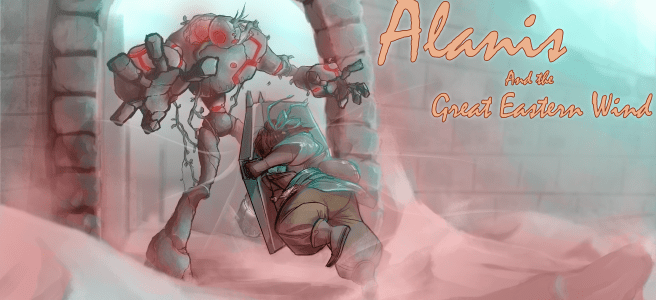
The goal of Alanis and the Great Eastern Wind was to create a high standard vertical slice of an adventure game using Unreal Engine 4. Our goal was to have it stand out from everyone else, which we did achieve when we were awarded the Head of School Award for Most Impressive Advanced Diploma Game Project in recognition of the most impressive game development project completed by Year 2 students in the Advanced Diploma of Professional Game Development 2016. The team consisted of three programmers, two designers and five artists.
What Went Right as a Team
- The vertical slice and all of the proposed aspects of gameplay, mechanics and art were implemented as outlined in our original documentation.
- Most issues surrounding the project were resolved quickly, though not always to everyone’s satisfaction.
- The game concept was solid enough for what we were expected to create in the time allocated, and it was reasonably well thought out from the beginning.
- Most of the team were committed for the majority of the project even if interest wasn’t necessarily present at the beginning from everyone, myself included.
- Every member of the team was reasonably good at what they were expected to do.
- Our programmer/technical artist did amazing work with polishing the game’s visuals. He did, however, have a habit of tweaking bits of the map without telling anyone, which the level designer took as a personal attack, but overall what he did was incredibly valuable to the finished project.
What Went Wrong as a Team
- As a whole, the group worked well together, but there was a strong sense that each discipline was only respected for its discipline. This meant that the artists weren’t always open to suggestions about their art from the designers or programmers and the designers weren’t always open to suggestions from the artists or the programmers about level or mechanic design, and even at times the programmers did not want to hear suggestions from the artists or designers about something that could be improved.
- No team standards were formally set out at the beginning of the project meaning confusion and inconsistency with code, blueprints, and art assets, including wrong pivot points, sizes, naming conventions, etc.
- No iteration or willingness to improve on already implemented assets, features or gameplay puzzles. When suggestions were made for improvements, it was often met with hostility or a line of “maybe if we have time”. This primarily came from the level designer and at times from the art team. Though there were also instances of this occurring from the one programmer tasked with creating the AI as well.
- The artists were not willing to open the game engine and test their assets, meaning they had to rely on the programmers or designers. This resulted in lots of time delays in implementing assets, and time wasted by other members of the team who could’ve been focusing on other things.
- Our level designer spent 13/20 weeks building and rebuilding and shifting around the tiniest details of the map. His time could’ve been better spent designing slightly harder and more complicated puzzles that were originally expected in the project.
- Our third programmer, primarily in charge of AI, was very unwilling to use C++ and would only use Blueprints, which caused many issues when myself or the other programmer needed variables or functions from his code. It meant double handling as one of us would have to convert the Blueprint to C++, which did waste a lot of time. He also didn’t fully test his work, leading to a lot of time wasted towards the end of the project as he tried to fix it by essentially rebuilding it from scratch. He was also in charge of our version control, and was unwilling to fix the issues we encountered with it, as he took our requests for him to fix it as a personal attack on his abilities to set it up properly in the first place.
Originally written November 2016, edited and uploaded on 05 July 2017.
(Edited 26 February 2019)
 Aythan Maconachie